
Reading to the Shaykh vs. Hearing Directly
In our journey of studying sacred knowledge, we often ask:
Is it better to read to a shaykh or to hear the ḥadīth directly from their mouth?
This very question was debated by the great scholars of the past, and three primary opinions emerged. The scholars of the Ummah held three main views:
1. Equality Between the Two Methods
The first opinion is that reading to the shaykh and hearing directly from his mouth are equal in value. This was the view of Imām Mālik, his companions, and several others. According to this position, both methods are acceptable ways of receiving and transmitting knowledge.
2. Reading to the Shaykh is Superior
The second opinion, held by scholars such as Imām Abū Ḥanīfah and Ibn Abī Dh’īb, is that reading to the shaykh is superior to listening from him. Their reasoning? A student reading carefully may articulate better, ensuring clarity — while the shaykh can correct any mistake.
3. Hearing from the Shaykh is Superior
The third view, and the one preferred by the majority of scholars from the eastern regions of the Muslim world (Ahl al-Mashriq), is that hearing the ḥadīth directly from the shaykh is superior. This opinion was supported by the ḥadīth scholar Zayn al-Dīn al-ʿIrāqī, who stated:
Summary of the Three Views
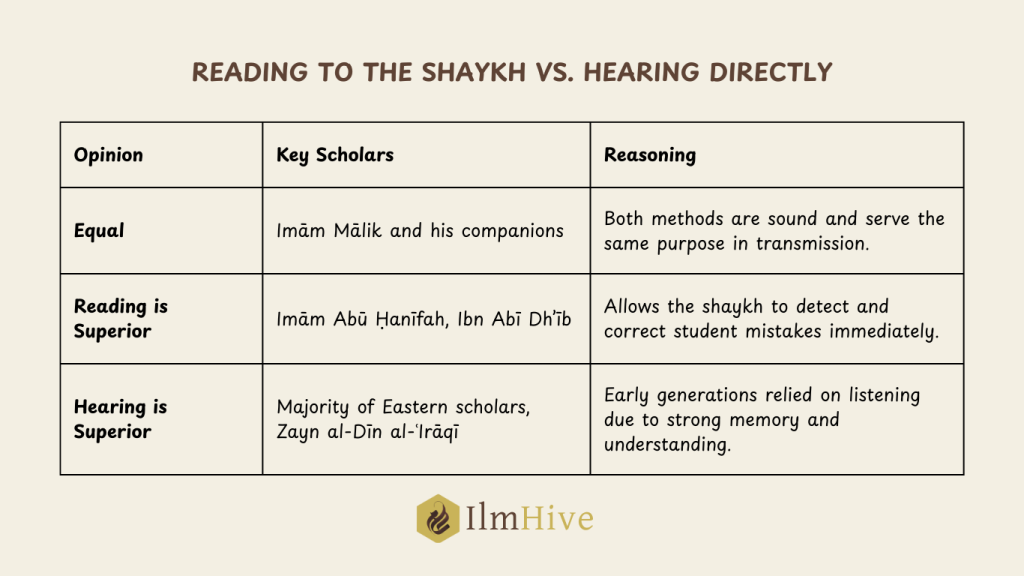
Discussion adapted from Nafḥ al-ʿUrf al-Shadhī fī Sharḥ Shamāʾil al-Tirmidhī, vol. 1, p. 94.
[1] Zayn al-Dīn al-ʿIrāqī, Jamʿ al-Wasāʾil fī Sharḥ al-Shamāʾil, vol. 1, p. 11.
Related notes
In the isnad of ahadith, we often see narrators say “حدّثنا” or “أخبرنا” when reporting what they heard from their teachers. But is there …
ReadArticle2 May 2025His Name and Birth He is Imam Abu Abdillah Muhammad ibn Isma’il Abi al-Hasan ibn Ibrahim ibn al-Mughirah ibn al-Bardizba …
ReadBiography3 March 2018عَنْ أَمِيرِ الْمُؤْمِنِينَ أَبِي حَفْصٍ عُمَرَ بْنِ الْخَطَّابِ رَضِيَ اللهُ عَنْهُ قَالَ: سَمِعْتُ رَسُولَ اللَّهِ صلى الله عليه وسلم يَقُولُ: …
ReadLesson26 February 2021باب كَيْفَ كَانَ بَدْءُ الْوَحْىِ إِلَى رَسُولِ اللَّهِ صلى الله عليه وسلم Imam Bukhari does not label this section as ‘kitab’ but rather as ‘bab’[1]. The difference between kitab, …
ReadLesson26 February 2021