
Islam and Iman
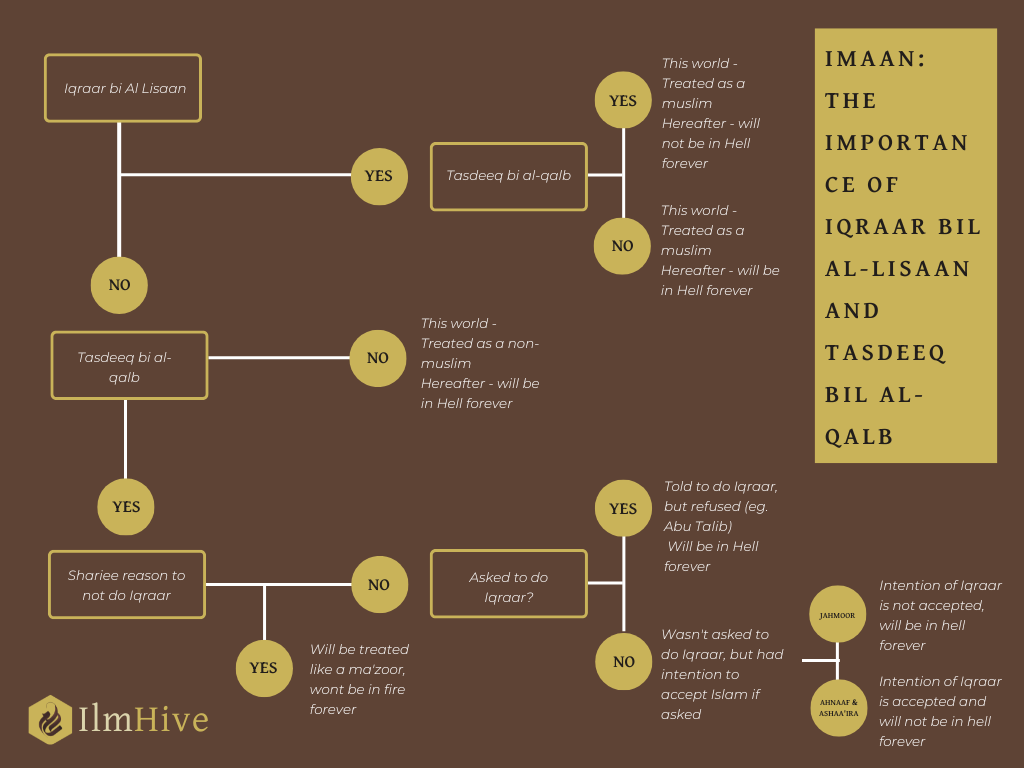
Islām is a way of life. Another definition of Islām is inqiyād ẓāhirī, which is the manifestation of taṣdīq through actions.
Imān can be thought of as taṣdīq bi al-qalb (affirmation in the heart), and Islām as a’māl (actions).
It seems as though the two words, Islām and Imān are different in meaning. For example in the following ayah:
Even though, in essence they may be different, in sharī’ah to be beneficial, from a certain perspective they are closely bonded together. For example, for Imān to be considered then part of Islām is needed ie. in order for a person to be considered to have Imān, then there needs to be some manifestation of this Imān through their Islām (actions).
Iqrār (affirmation) is a compulsory tenet of Imān, and Islām is a condition of Imān. Two things which are different in essence can be dependent on each other. For example, take the sun and daytime, although they are two different things, you cannot get daytime without the sun.
The importance of Iqrār bi al-lisān, in order for Imān to be accepted
For the ruling of Muslims to apply in this world, Iqrār bi al-lisān (affirmation with the tongue) is a condition by consensus of the scholars ie. if a person did taṣdīq but did not do iqrār then the ruling of Muslims in this world will not apply.
Related notes
The importance of actions with regards to Iman? From the mutakalimeen / Ahnaf point of view, Iman is tasdeeq bi …
ReadArticle21 July 2018According to the Ahnaf, Jamhoor Mutakalimeen, Imam al-Haramayn al-Shafiee Iman does not increase or decrease. On the other hand, Imam …
ReadArticle22 July 2018The definition of majhūl[1] is that narrator whose condition is not known,[2] and this narrator is not known for seeking knowledge. Thus, …
ReadLesson13 June 2023باب كَيْفَ كَانَ بَدْءُ الْوَحْىِ إِلَى رَسُولِ اللَّهِ صلى الله عليه وسلم Imam Bukhari does not label this section as ‘kitab’ but rather as ‘bab’[1]. The difference between kitab, …
ReadLesson26 February 2021